Home› Health Guides› Primary Care
High Blood Pressure: Why It Has No Symptoms, and What the Two Numbers Mean
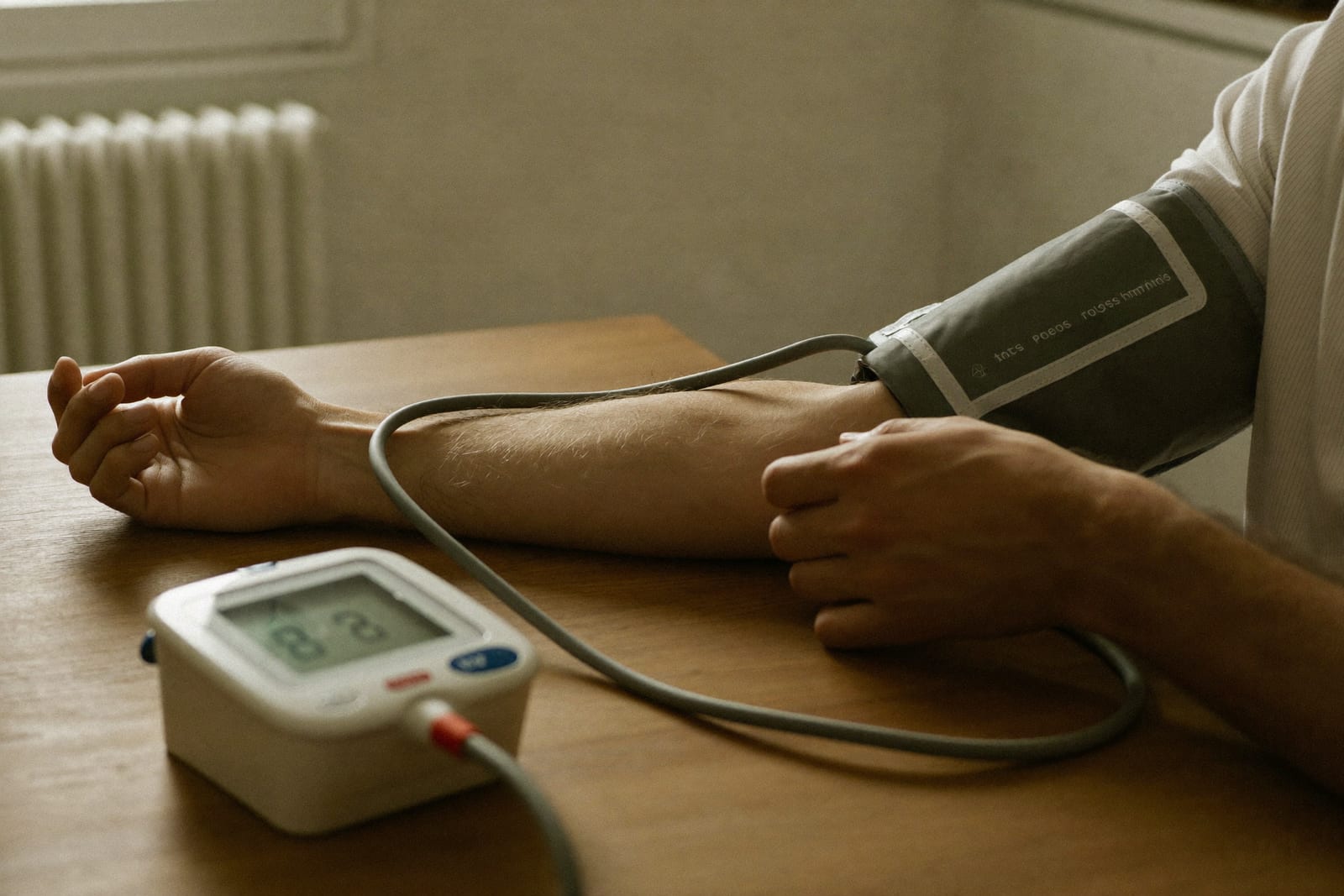
High blood pressure does not make you feel unwell. Not at the start, not for years, and usually not until it has already done something.
That single fact explains everything difficult about it. It is why people stop taking medicine that is working — because nothing feels different either way. It is why a reading gets noticed at a pharmacy and then not followed up. And it is why the only reliable way to know is to have it measured.
If someone has told you a reading was high, the useful next step is not to worry about that reading. It is to get it measured properly, more than once, because a single number in a noisy setting is not a diagnosis.
The two numbers
The top number (systolic) is the pressure while your heart is pushing. The bottom number (diastolic) is the pressure while it is refilling. Both matter, and above about age 50 the top number is generally the more informative one.
Roughly, and for adults:
| Top | Bottom | ||
|---|---|---|---|
| Normal | under 120 | and | under 80 |
| Elevated | 120–129 | and | under 80 |
| Stage 1 | 130–139 | or | 80–89 |
| Stage 2 | 140 or above | or | 90 or above |
Two things worth knowing about that table.
“Or”, not “and”, from Stage 1 onward. Either number on its own puts you in the band. A reading of 135 over 75 is Stage 1.
These are diagnostic categories, not a scoreboard. What we do about 134 over 84 depends far more on your age, your kidney function, your cholesterol, whether you smoke, and whether you have diabetes than on the number itself. Two people with identical readings can correctly get different advice, and that is not inconsistency.
Readings that need attention now
Above about 180 over 120, rest for five minutes and measure again. If it is still that high, call us the same day.
Call 911 if a reading that high comes with chest pain, breathlessness, weakness or numbness on one side, difficulty speaking, vision loss, severe headache, or confusion. Those are the signs of damage happening, and they are an emergency rather than an appointment.
Why one reading is not a diagnosis
Blood pressure is not a fixed property of a person. It moves through the day, and plenty of ordinary things push it up by enough to change which band you land in.
- Being in a clinic. This is real and it has a name — white coat hypertension — and it is why we may ask you to measure at home
- Caffeine in the last half hour, or a cigarette
- A full bladder, which adds a surprising amount
- Talking during the measurement
- Crossed legs, an unsupported arm, or a cuff over a sleeve
- A cuff that is the wrong size. Too small reads high, and this is the most common measurement error there is
- Rushing in. Five minutes sitting quietly first changes the number
Measuring at home is often more informative than measuring here, which is not a criticism of either. Home readings over a week or two, morning and evening, describe your actual blood pressure better than two readings taken in a room you were hurrying to get to.
If you buy a monitor: an upper-arm cuff, not a wrist or finger device. Get the cuff size right. Bring it in so we can check it against ours.
What actually lowers it
Ranked by how much difference each makes.
1. Salt, and mostly not the salt cellar. Around three-quarters of the sodium most people eat is already in the food before it reaches them — bread, cheese, cured and processed meat, sauces, tinned soup, restaurant food, anything described as “crispy”. Reading labels beats putting the shaker away, and for people whose blood pressure is salt-sensitive the effect can be substantial.
2. Losing a modest amount of weight, if you carry extra. Roughly a point off the top number per kilogram lost, which adds up faster than people expect.
3. Movement — about 150 minutes a week. Brisk walking is enough. Some resistance work adds more. Effects appear within weeks and disappear if you stop, which is worth knowing so a plateau does not read as failure.
4. Potassium, from vegetables, fruit, beans and lentils. It works with sodium reduction rather than instead of it. One caution: if you have kidney disease or take certain blood pressure medicines, do not increase potassium or use a potassium-based salt substitute without asking us first — for some people that is genuinely unsafe.
5. Alcohol. One of the more reliable levers, and one of the least popular.
6. Sleep, and especially sleep apnoea. If you snore heavily, stop breathing in your sleep, or wake unrefreshed, this is worth investigating — untreated sleep apnoea is a common cause of blood pressure that will not come down despite everything else, including medication.
7. Stopping smoking. It does less to the long-term number than people assume and far more to the thing the number is a proxy for, which is your risk of a heart attack or a stroke.
What has little or no evidence: most supplements sold for blood pressure. Tell us what you are taking anyway — some genuinely interact, and several common over-the-counter medicines raise blood pressure themselves, including NSAIDs like ibuprofen and naproxen, decongestants, and some herbal preparations.
About the medication
Most people who need treatment end up on more than one medicine at a lower dose, rather than one at a high dose. That is deliberate and it is not a sign that things are going badly — different drugs act on different mechanisms, and combining them gives better control with fewer side effects than pushing a single one to its limit.
Some will be lifelong, and that is not a failure of the lifestyle changes. Blood pressure has a strong genetic component. Doing everything right and still needing a tablet is an extremely common outcome.
If a medicine is causing side effects, tell us instead of stopping it. There are several classes and the usual answer is to switch, not to endure. The dry cough some people get is a well-known effect of one particular class and there is a direct alternative.
And the honest ask: keep taking it when you feel fine. Feeling fine is what success looks like here. It is not evidence you no longer need it.
Who should get checked, and when
- Every adult, at least every couple of years if readings are normal, and at least annually from 40 — or more often if readings have been in the elevated or Stage 1 range
- Sooner if you have diabetes, kidney disease, or a family history
- In pregnancy, where blood pressure is monitored closely and a rise matters urgently — if you are pregnant and have a high reading, headache, vision changes or swelling, that is a same-day call
- Children and teenagers get checked at well-child visits. High blood pressure in a child is uncommon, real, and nearly always found by measuring rather than by symptoms
It takes two minutes, it happens at any visit, and you can ask for it without a reason. Our annual visits page covers what else gets checked at the same time.
The Arizona part
Heat changes this, and the standard advice does not mention it.
In high heat your blood vessels dilate and you lose fluid through sweat, which can drop blood pressure — sometimes enough to cause dizziness or a faint, particularly in people taking blood pressure medicine, and especially with diuretics. If you feel lightheaded standing up during a Phoenix summer, that is worth a conversation rather than an assumption. It may mean a dose needs adjusting for the season, and that is a normal thing to do, not a sign of anything going wrong.
Do not stop or change a dose yourself. The correction is usually small and it needs a reading.
Two things that push the other way. Dehydration concentrates you and makes you feel worse in ways that get blamed on the medicine. And some medicines for blood pressure make it harder to handle heat — diuretics by adding fluid loss to fluid loss, beta blockers by blunting the heart-rate response, and some by reducing how well you sweat. That is not a reason to stop them; it is a reason to be deliberate about shade, timing and water. Our heat safety page covers where the real line is.
Sources
- High blood pressure in adults — hypertension — MedlinePlus Medical Encyclopedia, U.S. National Library of Medicine. https://medlineplus.gov/ency/article/000468.htm
A note on this article: This information is general health education and is not a substitute for a visit with a provider. If you have a concern about your health or your family’s health, call us and we will help.